Six Historical Phases
The evolution of Balvill from feudal tenure to incorporeal dignity
Creation
1630–1633
Crown charter granted by King Charles I (5 August 1630) to Archibald Campbell, Lord Lorne, uniting mainland Stirlingshire and Inner Hebrides holdings. Confirmed by Act of Parliament (28 June 1633). The beginning of 395 years with the Campbell family.
Powers & Jurisdiction
1630–1747
Period of full baronial rights including jurisdictional powers (soke and sake, toll and theame, infangthief and outfangthief), capital punishment (pit and gallows), and feudal superiority over lands. Baron held dominium directum while land possessors held dominium utile.
Campbell Dynasty
1630–2025 (395 years)
Continuous association with the Campbell family despite two forfeitures and executions (1661, 1685), both later rescinded. Held through dramatic political upheavals from the 8th Earl/1st Marquess through to the 13th Duke of Argyll, spanning the reigns of 17 British monarchs.
Transformation
1747–2004
Progressive erosion of baronial powers. 1747: Heritable Jurisdictions Act abolishes all judicial and administrative powers. 19th century: Separation of feudal superiority from land possession accelerates. Barony becomes increasingly titular while retaining legal recognition under Scots law.
Modern Law
2004
Abolition of Feudal Tenure Act 2000 comes into force (28 November 2004), ending all feudal land tenure in Scotland. The "dignity of baron" preserved as incorporeal heritable property—a legal right existing independently of land, capable of being owned, transferred, and inherited.
Transfer
2025
First time since 1630 that the barony passes outside the Campbell family. Deed of assignation (9 September 2025) transfers the dignity from Torquhil Ian Campbell, 13th Duke of Argyll, to Mark Hopking. Registered with Scottish Barony Register and listed in Debrett's.
Contents
Introduction
The Barony of Balvill occupies a distinctive position in the history of Scottish feudal dignities. Created by Crown charter in 1630 and continuously associated with the Campbell family for 395 years, it has survived forfeitures, executions, the abolition of heritable jurisdictions, Jacobite risings, the abolition of heritable jurisdictions, and the final dissolution of feudal land tenure itself.
This history traces the barony from its creation as a composite feudal holding—spanning territories from Stirlingshire to the Inner Hebrides—through the dramatic fortunes of the Campbell dynasty, the gradual erosion of baronial powers, and its ultimate transformation into an incorporeal heritable dignity under modern Scots law.
Understanding Scottish Feudal Baronies
Origins in the Feudal System
Scottish feudal baronies trace their origins to the 12th century, when King David I (r. 1124–1153) systematically introduced Norman feudal institutions to Scotland.[1] Having spent much of his youth at the court of his brother-in-law, Henry I of England, David recognised the administrative and military advantages of feudalism and imported the system wholesale upon his accession to the Scottish throne.
David granted baronies to Anglo-Norman and Flemish knights and aristocrats in exchange for ward—the obligation to provide the Crown with armed men and mounted knights when required. These grants were recorded in charters that erected lands in liberam baroniam (in free barony), directly from the Crown.[1] By the time of Robert I in the early 14th century, there were perhaps 200 to 300 baronies; by 1405 this had risen to 400, and by 1707, as James VI & I and his Stuart successors consolidated their joint kingdoms, the total approached 1,500.[1]
The Feudal Hierarchy: Superiority vs. Possession
One of the most commonly misunderstood aspects of Scottish feudal baronies concerns the relationship between the barony itself and actual ownership of the land. This confusion arises from the dual nature of feudal landholding under Scots law, which recognised two distinct forms of right over the same land:
Dominium Directum (Feudal Superiority)
This was the superior's right—in the case of a barony, held by the baron. The feudal superior held the ultimate title to the land but did not necessarily occupy or directly control it. The superior received feudal duties (feu-duties) from those who actually held the land below them in the feudal chain.
Dominium Utile (Beneficial Possession)
This was the right of the actual possessor or occupier of the land—the person who worked it, lived on it, and exercised practical control over it. This vassal held the land heritably and could sell or bequeath it, subject to the superior's rights.
These two rights could be—and frequently were—held by entirely different people. A baron might be the feudal superior of extensive lands without owning or occupying any of them directly. The institutional writer Lord Bankton explained that "the dignity of a barony" existed as a noble quality of the feudal grant, independent of whether the baron actually resided on or personally controlled the lands.[2]
What Baronies Conferred
Early grants of baronies typically contained the formula "soke and sake, toll and theame, infangthief and outfangthief." These Anglo-Norman and Anglo-Saxon terms, imported by David I, granted substantial jurisdictional powers:[1]
- Soke and sake: The right to hold courts and administer justice, substituting local baronial jurisdiction for the King's national courts.
- Toll and theame: The right to levy tolls on passage and sale of goods, and to hold courts concerning theft and retain the profits.
- Infangthief and outfangthief: The right to try and punish (including execution) thieves caught within the barony's jurisdiction.
These jurisdictional privileges were symbolised by fossa et forca (pit and gallows)—the baron's right to capital punishment. Barons could also hold fairs and markets, create burghs of barony to control trade, and exact various feudal payments and services.[1]
However, it is crucial to understand that Scottish feudal barons were not peers. The lowest rank of the Scottish peerage was Lord of Parliament, entirely distinct from feudal barons. While originally all barons could attend Parliament as part of the Estate of the Barons, by 1428 there were so many that they began electing commissioners to represent them.[3] An Act of 1587 confirmed this arrangement and made clear that barons were no longer part of the nobility.[4] At the Union of Parliaments in 1707, feudal barons had no place in Westminster.
Creation of the Barony of Balvill (1630–1633)
Historical Context
The creation of the Barony of Balvill in 1630 must be understood against the backdrop of Charles I's troubled reign and the political ascendancy of the Campbell family in western Scotland. Archibald Campbell, Lord Lorne—the grantee—was the son of the 7th Earl of Argyll, a Catholic convert who had been forced into exile and declared a traitor in 1619.[5]
By 1630, Lord Lorne had secured royal favour and was consolidating Campbell power through strategic acquisitions and royal grants. The creation of Balvill formed part of a broader pattern: between 1625 and 1632, Charles I granted Lorne several composite baronies—Ardnamurchan (1625), Balvill (1630), and Gigha (1632)—each uniting dispersed Campbell holdings under a single baronial dignity.[6]
The 1630 Crown Charter
On 5 August 1630, at the Palace of Holyroodhouse in Edinburgh, King Charles I granted a Crown charter under the Great Seal of Scotland creating the Barony of Balvill.[7] The charter, recorded in the Register of the Great Seal as number 1623, granted the barony to:
Archibald Lord Lorne &c., and his heirs male and assignees whatsoever
The charter united various lands and jurisdictions previously held separately, incorporating them into a single barony. Crucially, the charter designated "the manor place of Baluill to be the principal messuage"—that is, the caput baroniae or head of the barony in the Parish of Drymen, Stirlingshire.
What made Balvill distinctive was its composite nature. While the caput lay in mainland Stirlingshire, the barony also incorporated holdings in the Inner Hebrides—including lands in Jura, the island of Oronsay, and territories in Colonsay—creating a geographically dispersed feudal domain reflecting extensive Campbell territorial interests in western Scotland.
Parliamentary Confirmation (1633)
On 28 June 1633, the Scottish Parliament passed an Act formally ratifying and confirming the barony.[6] This parliamentary confirmation added legislative authority to the Crown charter, providing a dual foundation for the barony's legal existence—both royal prerogative and statutory enactment.
The Campbell Dynasty (1630–2025)
For 395 years, from 1630 to 2025, the Barony of Balvill remained continuously associated with the Campbell family and the Dukes of Argyll, despite two forfeitures and executions, both later rescinded. This extraordinary continuity persisted through some of the most turbulent periods in Scottish and British history.
The Tragic Fate of the First Two Holders
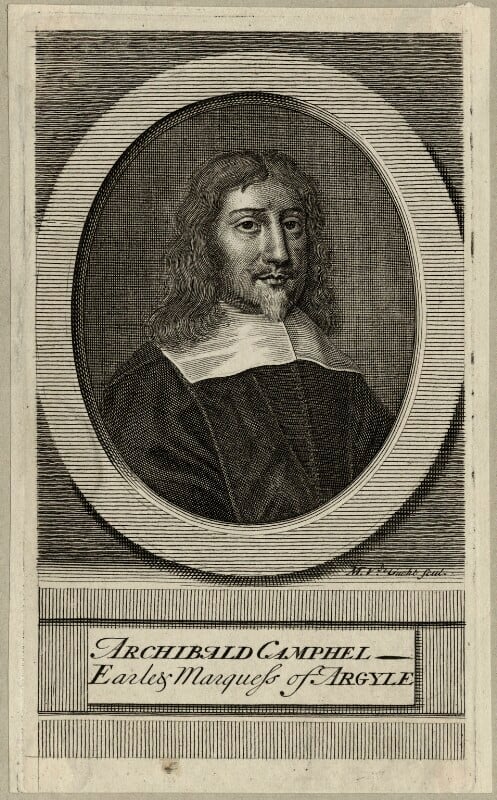
Archibald Campbell, 8th Earl and 1st Marquess of Argyll—the original grantee—became one of the most powerful figures in Scotland during the Wars of the Three Kingdoms. He led the Covenanter movement, crowned Charles II at Scone in 1651, yet was executed for high treason in 1661 following the Restoration.[8]
His son, Archibald Campbell, 9th Earl of Argyll, succeeded to the forfeited estates but was himself executed in 1685 for his role in Argyll's Rising against James VII & II. Both forfeitures were rescinded: the 9th Earl's in 1689,[9] demonstrating that even execution and attainder could not permanently sever the Campbell connection to their baronial dignities under Scots law.
The Later Campbell Holders
Subsequent holders included figures of national prominence. Archibald Campbell, 3rd Duke of Argyll (1682–1761) served as first Governor of the Royal Bank of Scotland and appears on RBS banknotes to this day.[10] Through all the political upheavals—the Union of 1707, the Jacobite risings, the abolition of heritable jurisdictions in 1747—the barony remained with the Campbells, though its practical significance diminished with each erosion of baronial power.
Erosion of Baronial Powers
The 1747 Turning Point
The Heritable Jurisdictions (Scotland) Act 1747, enacted by the Parliament of Great Britain following the Jacobite Rising of 1745, abolished all heritable jurisdictions in Scotland.[11] Barons lost their courts, their jurisdictional powers, and their right to administer justice. The Act compensated those holding jurisdictions at the time, but the baronial powers themselves—soke and sake, toll and theame, infangthief and outfangthief—were permanently extinguished.
From 1747 onwards, baronies existed primarily as feudal superiorities—legal titles conferring the right to receive feu-duties but carrying no governmental or judicial authority. The dignity of baron persisted, but it had become largely titular.
The Separation of Superiority and Possession
Throughout the 18th and 19th centuries, the separation of feudal superiority from actual land possession became increasingly pronounced. The Dukes of Argyll retained the barony—the feudal superiority—while the lands themselves were held by various possessors who paid feu-duties but otherwise had complete practical control.
This created the curious situation where the Baron of Balvill might never set foot on the lands of Balvill, residing instead at Inveraray Castle, yet still held the legal dignity of the barony under Scots law.
Modern Transformation (2004)
The final transformation came with the Abolition of Feudal Tenure etc. (Scotland) Act 2000, which received Royal Assent on 9 June 2000 and came into force on 28 November 2004.[12][13] This Act ended all feudal land tenure in Scotland, sweeping away the entire system that had existed since the 12th century.
However, Section 63 of the Act specifically preserved "the dignity of baron":
- All land in Scotland became held outright by its possessor (dominium plenum), free of feudal obligations.
- The barony itself—the dignity—was preserved as incorporeal heritable property, capable of being owned, transferred by assignation, and inherited.
- The barony no longer carried any rights over land, jurisdiction over people, or entitlement to feudal payments.
This transformation fundamentally changed what a Scottish barony is. From 1630 to 2004, Balvill had been a feudal tenure—a way of holding land with associated rights and obligations. After 2004, it became purely a dignity—a recognised title of honour under Scots law, but one with no territorial or jurisdictional content.
Various registration systems emerged to record these dignities. The Scottish Barony Register maintains an official register of baronies, entries in which may be marked private if the holder chooses. Authoritative directories such as Debrett's also list recognised Scottish baronies.[14][15]
The 2025 Transfer
In 2025, after 395 years of continuous association with the Campbell family and the Dukes of Argyll, the dignity of the Barony of Balvill was assigned to Mark Hopking.
Under modern Scots law, baronies are transferred by deed of assignation—a formal legal document assigning the incorporeal right from the previous holder to the new one. The assignation was executed on 9 September 2025, transferring the barony from Torquhil Ian Campbell, 13th Duke of Argyll, to Mark Hopking.[16]
Following the assignation, the transfer was registered, and the barony now appears in recognised directories and registers. The Scottish Barony Register's official list includes Balvill, with the holder's details marked as private.[14] Debrett's directory of feudal baronies lists Mark Hopking as Baron of Balvill.[15]
The 2025 transfer represents a significant transition in the barony's long history—the first time since 1630 that it has passed outside the Campbell family. Yet it also demonstrates the continuity of Scots law: a dignity created by Crown charter in 1630, confirmed by Parliament in 1633, held through centuries of political upheaval, transformed by the abolition of feudalism in 2004, can still be recognised, transferred, and held under the law in 2025.
The current holder has expressed his understanding of the dignity as a form of custodianship—preserving a nearly 400-year-old legal and historical entity while recognising that its significance today lies in historical continuity rather than territorial jurisdiction or political power.
395 Years: A Visual Journey
The complete story of the Barony of Balvill from 1630 to 2025, shown alongside the dramatic history of the Campbell family and the tumultuous events that shaped Scotland and Britain
Barony Quick Facts
- Created
- 5 August 1630 (Crown charter)
- Confirmed
- 28 June 1633 (Act of Parliament)
- Original grantee
- Archibald Campbell, Lord Lorne (later 8th Earl & 1st Marquess of Argyll)
- Caput
- Balvill, Parish of Drymen, Stirlingshire
- Extended holdings
- Inner Hebrides (Jura, Oronsay, Colonsay)
- Campbell holding
- 1630–2025 (395 years)
- Legal status (pre-2004)
- Feudal tenure with superiority rights
- Legal status (post-2004)
- Incorporeal heritable property
- Current holder
- Mark Hopking (since 9 September 2025)
- Registered
- Scottish Barony Register, Debrett's
References
- Durie, Dr. Bruce. The Barony and Barons of Balvill or Balwill: An historical and genealogical report for Mark Hopking, Baron of Balvill. Copyright © 2025. Pages 2–8. [Return to text]
- Lord Bankton (Andrew MacDouall). An Institute of the Laws of Scotland in Civil Rights. Edinburgh, 1751–1753. Volume 2, Title 3, §§153–154. [Return to text]
- Acts of the Parliament of Scotland 1424 c.4. Records of the Parliaments of Scotland to 1707. University of St Andrews, 2007–2025. https://www.rps.ac.uk/ [Return to text]
- Acts of the Parliament of Scotland 1587 c.116. Records of the Parliaments of Scotland to 1707. University of St Andrews, 2007–2025. [Return to text]
- Durie, Dr. Bruce. The Barony and Barons of Balvill. Page 9 (7th Earl of Argyll's conversion and exile). [Return to text]
- Acts of the Parliament of Scotland [1633/6/92]. Act in favour of [Archibald Campbell], lord Lorne, 28 June 1633. https://www.rps.ac.uk/trans/1633/6/92 [Return to text]
- Crown Charter under the Great Seal of Scotland, dated 5 August 1630 at Holyroodhouse. Register of the Great Seal, Book LII, No. 1623. National Records of Scotland. [Return to text]
- Argyll Transcripts, dated 14 December 1630, recording the Charter of 5 August 1630 and creation of the "barony of Balweill." [Return to text]
- Acts of the Parliament of Scotland [1660/1/85]. Act rescinding a clause in the address made by the parliament against the late earl of Argyll, 13 June 1660. [Return to text]
- Acts of the Parliament of Scotland [1685/4/99]. Act anent the address of the estates of parliament... to his majesty, 11 June 1685. [Return to text]
- Acts of the Parliament of Scotland [1689/3/108]. Act rescinding the forfeiture of the late Archibald Campbell earl of Argyll, 5 June 1689. [Return to text]
- Heritable Jurisdictions (Scotland) Act 1747 (20 Geo. II c.43). An Act for taking away and abolishing the Heritable Jurisdictions in that Part of Great Britain called Scotland. [Return to text]
- Abolition of Feudal Tenure etc. (Scotland) Act 2000 (asp 5). Section 63: Preserved right to the dignity of baronage. Scottish Parliament. [Return to text]
- Deed of Assignation transferring the Barony of Balvill from Torquhil Ian Campbell, 13th Duke of Argyll, to Mark Hopking. Dated 9 September 2025. Registration pending with Scottish Barony Register. [Return to text]
- Debrett's Peerage and Baronetage, 2025 edition. "The Feudal Baronies of Scotland." https://debretts.com/directories/other-titles-2/the-feudal-baronies-of-scotland/ [Return to text]
- Smith, John Guthrie. Strathendrick and its inhabitants from early times; an account of the parishes of Fintry, Balfron, Killearn, Drymen, Buchanan, and Kilmaronock. Glasgow: James Maclehose and Sons, 1896. [Return to text]
- The New Statistical Account of Scotland, Volume 8. Parish of Drymen. Edinburgh: William Blackwood and Sons, 1845. [Return to text]
- "Massacre of Glencoe." Wikipedia. Last modified December 2024. https://en.wikipedia.org/wiki/Massacre_of_Glencoe [Return to text]
- "The Glencoe Massacre." National Trust for Scotland. Accessed January 2026. https://www.nts.org.uk/visit/places/glencoe/the-glencoe-massacre [Return to text]
- "Massacre of Glencoe." Encyclopædia Britannica. Last modified July 1998. https://www.britannica.com/event/Massacre-of-Glencoe [Return to text]
- "The Massacre of Glencoe." Glencoe Museum. Accessed January 2026. https://www.glencoemuseum.com/post/murt-ghlinnhe-comhann-the-murder-of-glencoe [Return to text]
- "What happened at the Glencoe Massacre." Scottish Tours Blog. Accessed January 2026. https://www.scottishtours.co.uk/blog/what-happened-at-the-glencoe-massacre/ [Return to text]
- "Inveraray Castle." Wikipedia. Last modified December 2024. https://en.wikipedia.org/wiki/Inveraray_Castle [Return to text]
- "Inveraray Castle." Clan Campbell Society of North America. Accessed January 2026. https://www.ccsna.org/inveraray-castle [Return to text]
- "History." Inveraray Castle Official Website. Accessed January 2026. https://www.inveraray-castle.com/castle/history [Return to text]
- "Inveraray Castle." Historic Houses Association. Accessed January 2026. https://www.historichouses.org/house/inveraray-castle-gardens/ [Return to text]
- "Archibald Campbell, 9th Earl of Argyll." Wikipedia. Last modified December 2024. https://en.wikipedia.org/wiki/Archibald_Campbell,_9th_Earl_of_Argyll [Return to text]
- "Archibald Campbell, 9th Earl of Argyll." Clan Campbell Society of North America. Accessed January 2026. https://www.ccsna.org/archibald-campbell-9th-earl-argyll [Return to text]
- "On This Day... 20 December 1681: The Elusive Earl of Argyll." The Cadies & Witchery Tours. Accessed January 2026. https://www.witcherytours.com/blog/2014/12/20/day-20-december-1681-elusive-earl-argyll [Return to text]
- "Archibald Campbell, 9th Earl of Argyll." Encyclopædia Britannica. Last modified July 1998. https://www.britannica.com/biography/Archibald-Campbell-9th-Earl-of-Argyll [Return to text]
- "Clan Campbell." Wikipedia. Last modified December 2024. https://en.wikipedia.org/wiki/Clan_Campbell [Return to text]
- "Clan Campbell History." Clan Campbell Society of North America. Accessed January 2026. https://www.ccsna.org/clan-campbell-history [Return to text]
- "Duke of Argyll." Wikipedia. Last modified December 2024. https://en.wikipedia.org/wiki/Duke_of_Argyll [Return to text]
- "Colin Campbell, 1st Earl of Argyll." Wikipedia. Last modified 2024. https://en.wikipedia.org/wiki/Colin_Campbell,_1st_Earl_of_Argyll [Return to text]
- "Archibald Campbell, 4th Earl of Argyll." Wikipedia. Accessed January 2026. https://en.wikipedia.org/wiki/Archibald_Campbell,_4th_Earl_of_Argyll [Return to text]
- "Archibald Campbell, 5th Earl of Argyll." Wikipedia. Accessed January 2026. https://en.wikipedia.org/wiki/Archibald_Campbell,_5th_Earl_of_Argyll [Return to text]
- "Campbell family." Encyclopædia Britannica. Accessed January 2026. https://www.britannica.com/topic/Campbell-family [Return to text]
- "Clan Campbell History." Discover Britain. Accessed January 2026. https://www.discoverbritain.com/history/clans/clan-campbell/ [Return to text]
- "Clan Campbell History." ScotClans. Accessed January 2026. https://www.scotclans.com/blogs/clans-c/clan-campbell-history [Return to text]
- "Covenanters." Wikipedia. Accessed January 2026. https://en.wikipedia.org/wiki/Covenanters [Return to text]
- "The Scottish Reformation, c.1525-1560." Scottish History Society. Accessed January 2026. https://scottishhistorysociety.com/the-scottish-reformation-c-1525-1560/ [Return to text]
- "Clan Campbell." University of Edinburgh, School of Divinity: The Breadalbane Collection. Accessed January 2026. https://divinity.ed.ac.uk/research/archival-collections-and-resources/the-breadalbane-collection/background/clan-campbell [Return to text]
- Campbell Clan History: A Comprehensive Chronicle. Compiled research document covering early origins to present (1625-present), including all Earls and Dukes of Argyll. Provided by user, January 2026. [Return to text]