Understanding the Barony
Three key aspects of Scottish feudal baronies and their modern status
Historical Foundation
Scottish feudal baronies originated in the 12th century as grants of land held directly from the Crown, carrying jurisdictional and economic privileges. Crucially, Scottish barons were never peers—they did not sit in Parliament after 1428, distinguishing them from Lords of Parliament.
Legal Transformation
The Abolition of Feudal Tenure Act 2000 severed the centuries-old connection between baronies and land ownership. When it came into force on 28 November 2004, the "dignity of baron" was preserved as incorporeal heritable property—a legal right existing independently of land.
Modern Status
Today, a Scottish barony confers no territorial jurisdiction, no automatic land ownership, and no seat in Parliament. It is a recognized dignity with historical significance, recorded in the Scottish Barony Register and listed in Debrett's.
The Barony of Balvill
Balvill was created as a feudal barony by King Charles I, granted to Archibald Campbell, Lord Lorne, who would later become the 8th Earl and 1st Marquess of Argyll. The charter united various lands and rights into a single barony, designating the manor place of Balwill in the Parish of Drymen, Stirlingshire, as the principal messuage or caput baroniae.
What made Balvill distinctive was its composite nature. While the caput lay in mainland Stirlingshire, the barony also incorporated holdings in the Inner Hebrides—including lands in Jura, the island of Oronsay, and territories in Colonsay—creating a geographically dispersed feudal domain reflecting extensive Campbell territorial interests in western Scotland.
The creation was confirmed by Act of Parliament on 28 June 1633. For nearly four centuries, Balvill remained continuously associated with the Campbell family and the Dukes of Argyll until 2025. Throughout history, the barony has been recorded with various spellings. Balvill was used within the original grant and in the subsequent Act of Parliament. Balwill is the adopted spelling of the Caput. Baluill has been used on occasion & within the 1840 Crown Charter it was spelt as Barwill. The 2025 assignation formally reverts the spelling to it's spelling of 1630-1633.
Timeline of Key Events
Comprehensive History
For detailed examination of the barony's creation, the complex relationship between feudal superiority and land ownership, the Campbell dynasty's turbulent history, and the legal evolution from medieval feudal holdings to modern incorporeal dignities.
Read Full History →References
- Durie, Bruce. "The origin, nature and present state of Feudal Baronies in Scotland" (2025). Report held by the Baron of Balvill.
- The Records of the Parliaments of Scotland to 1707, K.M. Brown et al. (eds), St Andrews, 2007–2025. Act 1587/7/143. Available online.
- Abolition of Feudal Tenure etc. (Scotland) Act 2000 (asp 5). legislation.gov.uk.
- Scottish Barony Register. Official Register of Baronies (updated 27 December 2025). PDF available.
- Debrett's. "The Feudal Baronies of Scotland." debretts.com.
- Registrum Magni Sigilli Regum Scotorum, Vol. VIII (1620–1633), edited by John Maitland Thomson (Edinburgh, 1894), no. 1623. Archive.org.
- The Records of the Parliaments of Scotland to 1707, 1633/6/92. Act in favour of Archibald Campbell, Lord Lorne (28 June 1633). Available online.
Barony Details
- Created
- 5 August 1630
- Confirmation
- 28 June 1633 (Act of Parliament)
- Original grantee
- Archibald Campbell, Lord Lorne
- Caput
- Balvill, Parish of Drymen, Stirlingshire
- Held by Argyll
- 1630–2025 (395 years)
- Current holder
- Mark Hopking (since 2025)
- Legal status
- Incorporeal heritable property
- Registry
- Scottish Barony Register, Debrett's
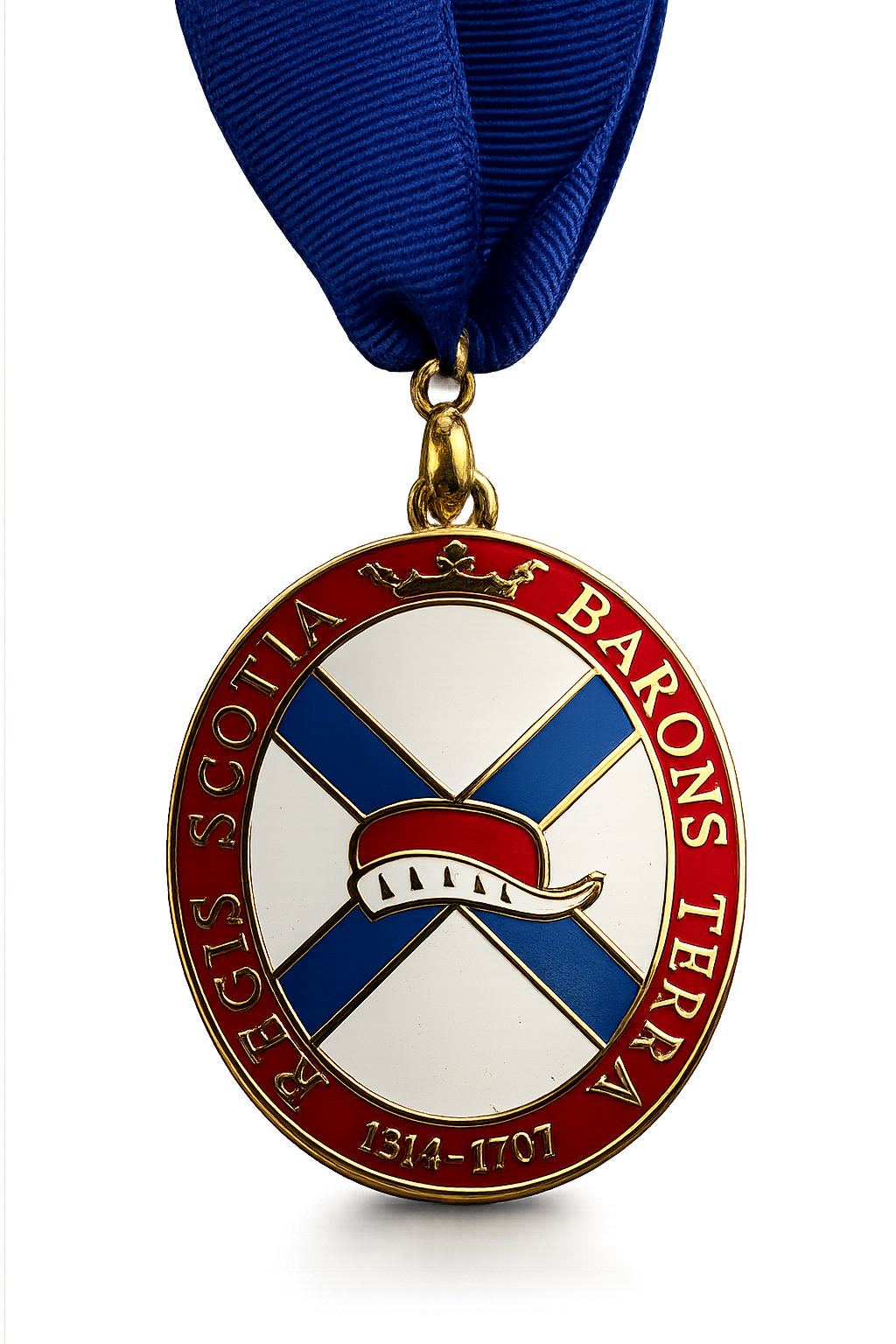
The Baron's Jewel — Regis Scotia Barons Terra, 1314–1707